PARADISE FOUND
Amidst noisy traffic and hordes of by-passers in the Mexico City center, a huge, dim-lit bamboo hut was created, where water and music transport us to a space seemingly made for meditation.
Three months after it’s opening, the “Nomadic Museum” hosting Canadian photographer Gregory Colbert’s “Ashes and Snow” exhibition has broken all assistance records. First of all it’s own, one million 500 visitors in all its previous showings, versus an almost 6 million people in Mexico alone.
It has also surpassed the visitor’s numbers of important museums such as the “Louvre” in Paris and New York’s “Metropolitan Museum”, this last having 4 million 600 in 2007. The “Nomadic Museum” has become the world’s most visited museum, an irresistible goal for any artist.
Colbert’s work makes us think in one of the essential concepts of our cultural history: the expulsion from the Garden of Eden, suggesting that it might’ve been ourselves, humans, who voluntarily abandoned it.
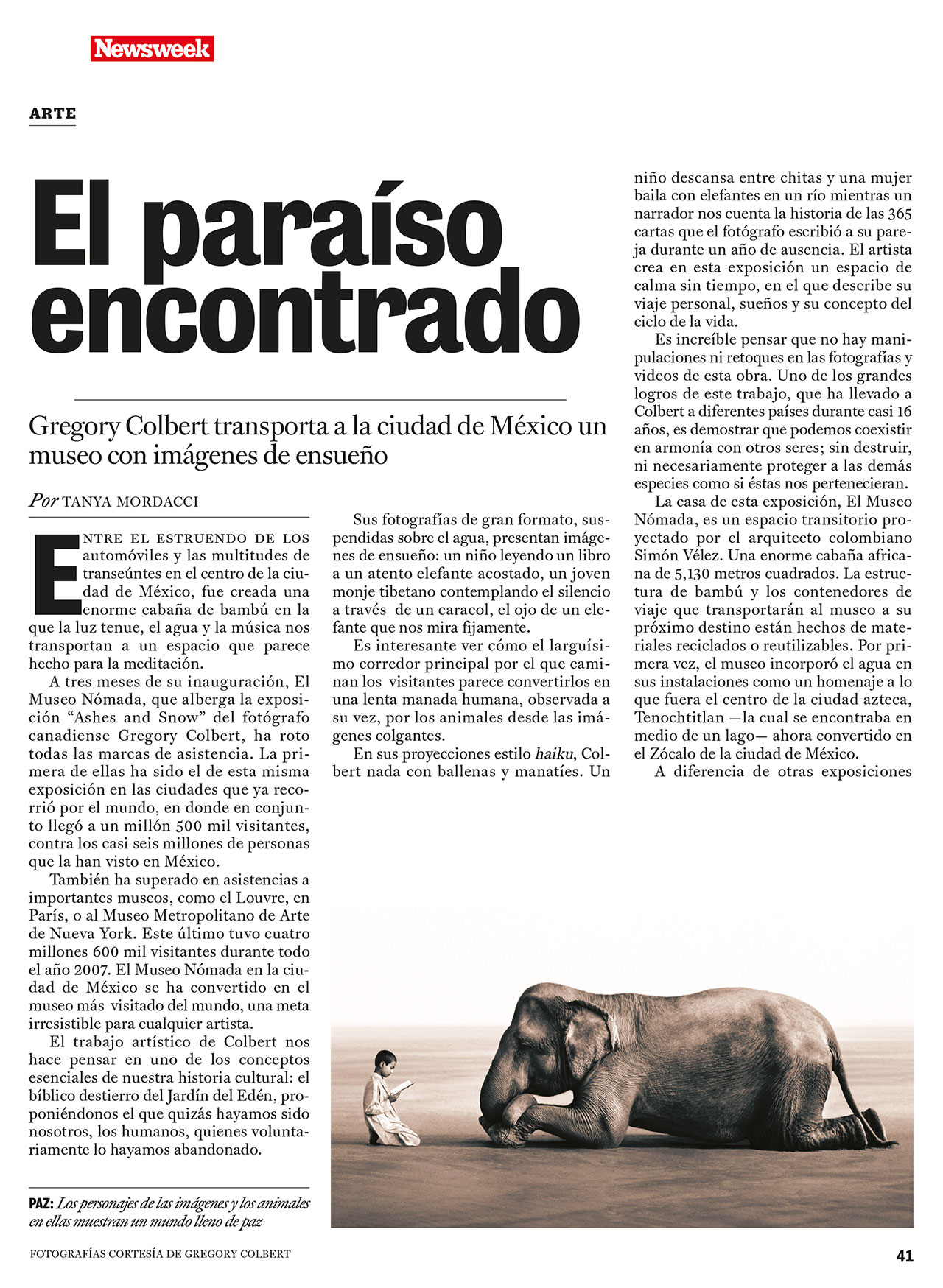
His large-scale photographs suspended above water present dream-like images: a boy reading a book to an attentive, laid down elephant, a young Tibetan monk contemplating silence through a conch, the eye of an elephant staring at us.
It’s interesting how in the long central corridor, walking visitors resemble a slow human herd being watched this time, by the animals from the hanging images.
In the “haiku” style projections, Colbert swims with whales and manatees. A boy rests between cheetahs and a woman dances with elephants in a river while the narrator tells the story of the 365 letters the photographer wrote during a year of absence.
The artist creates in this exhibition, a timeless, calm space describing a man’s personal journey, his dreams and his personal idea on the cycle of life.
It’s hard to believe there are no manipulations or touch-ups in his images. One of the great achievements in this body of work, which has taken Colbert through different countries for the last 16 years, is to prove that we can co-exist with other beings; harmoniously, without destroying or necessarily protecting species as if they belonged to us.
Housing this exhibition, the “Nomadic Museum” is a sustainable, transitory space projected by Simón Vélez. An enormous 5,130 mts. African hut. The bamboo structure and the travel containers which will transport the show to it’s next destination are all made from recycled or reusable materials.
For the first time, the museum incorporated water as a tribute to what once was the center of the Aztec city Tenochtitlán, -founded in the middle of a lake- now the Mexico City Zócalo.
Different to other solo shows where the public knows the artist and goes specifically to see the work, the “Nomadic Museum” went out and found it’s possible public.
Organized by Mexico City government and Televisa, sponsored by Rolex Institute and Telmex, this show placed in the center of one of the most busy areas in the city, in a very showy structure, with an easily understandable theme, and most of all, free of charge. This show has achieved the principal premise in art, universality.
From art-lovers to those who had never gone into a museum before have enjoyed this experience. “Ashes and Snow”, more than an exhibition has been felt like a stroll into human primordiality.
Art became part of everybody’s daily life, not only an elite’s. A very thoughtful proposal from the city government.
Colbert, with his honest and beautiful work, overturned for a few hours our conception of time, but most of all, “Ashes and Snow” leaves us with the utter sensation that paradise, more than a place or concept can be a state of mind.