WINNERS AND LOSERS
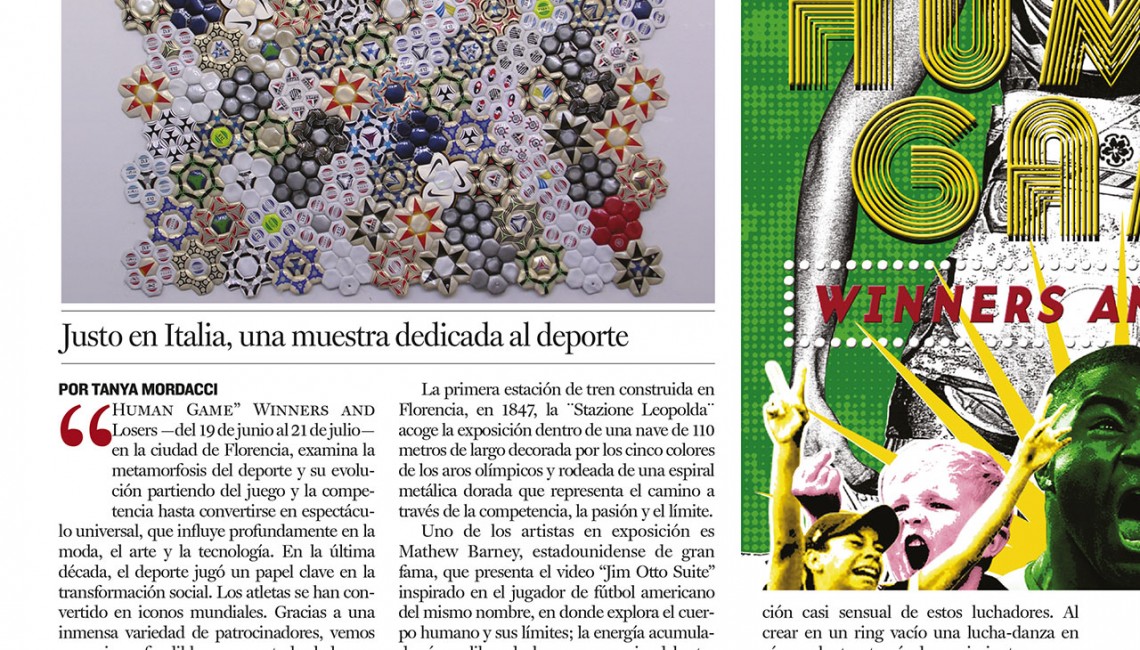
The City of Florence is hosting “Human Game” Winners and Losers.
The exhibition celebrates the intertwinement of sport, fashion and art as a crucial bond playing a central role in contemporary society. Sport has always been the meeting point for passion and desire as well as a metaphor of existence.
AAA Human Game examines the metamorphosis of sport and its evolution from play, competition and discipline –creating a universal spectacle AAA that encompasses and deeply influences technology, fashion, art, business and communication.
Florentine based organizers, “Pitti Discovery Foundation” with Francesco Bonami, also known as “Biennale of Venice” curator as artistic director, understand the importance of art, sport and fashion as fundamental in a world where globalization has been reduced partly to a universal recognition of signs and symbols. Their mission is to propose Florence as a hot spot in the contemporary arts circuit around the world by overlapping their rich artistic legacy to the newest avant-garde expressions utilizing the city’s spectacular locations, thus creating an atmosphere where past and present come alive.
Based at what used to be Florence’s first train station built in 1847, Stazione Leopolda, introduces us to the show inside its 110m long nave decorated with the five colors of the Olympic rings, surrounded by a gilt metal spiral netting representing the path through competition and passion, desire and limit.
AAA Artists from around the globe present us with their views on the physical, psychological and social implications sport has on individuals and on the masses.
Works such as Mathew Barney’s video installation “Jim Otto Suite”, based on football player Jim Otto, explores the human body and its limitations, accumulated energy not yet released and the consequences of increasing, extenuating training. Australian artist, Tracy Moffat, portrays in her Roller Derby photographic series, the anguish of battling against another team. Mexican Carlos Amorales takes on a more romantic, even sensual interpretation, showing two wrestlers in an empty ring wrestling in a slow-motion choreographed dance-fight.
There are four Latin American artists participating in this exhibition.
One Brazilian and four Mexican.
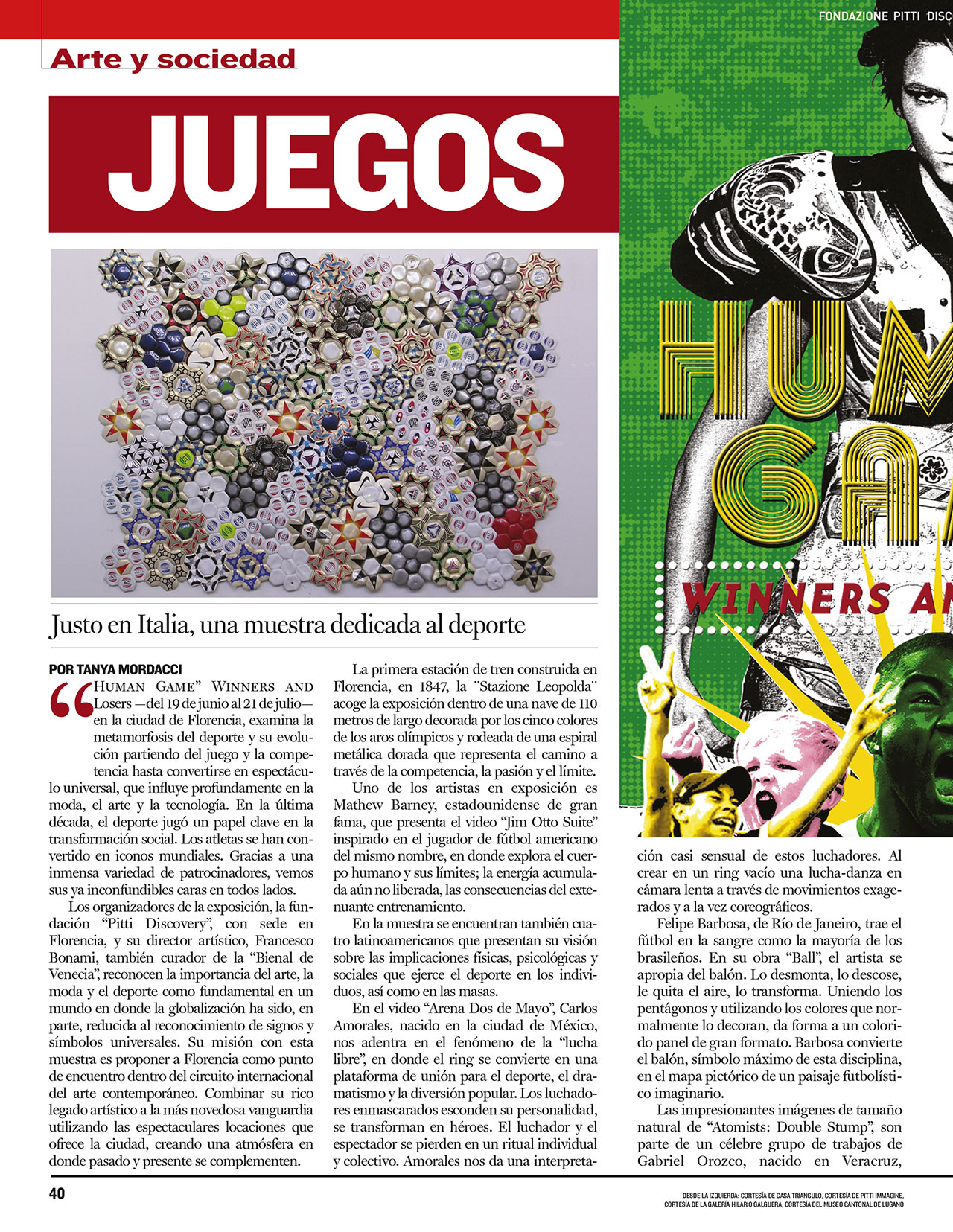
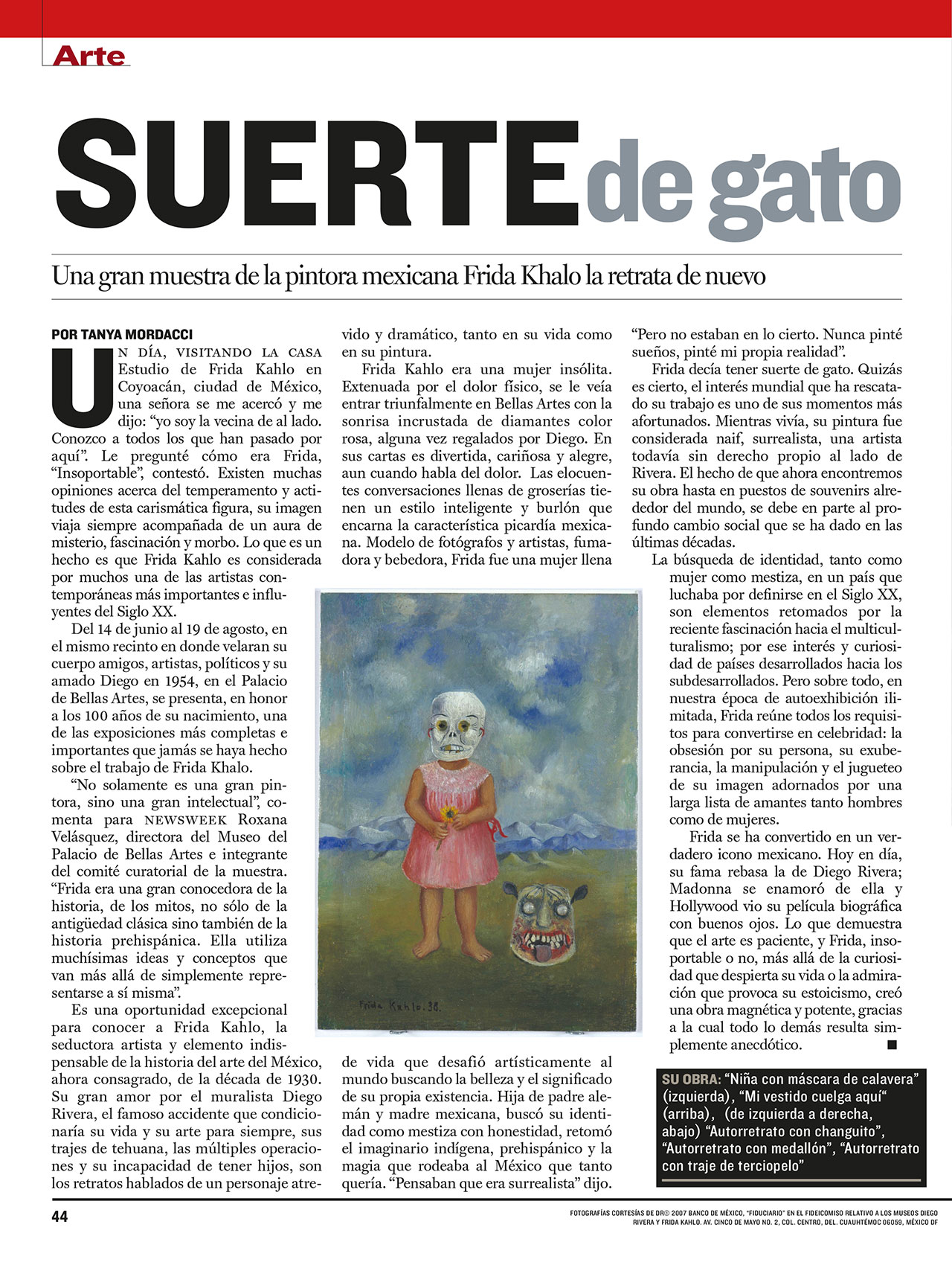
Felipe Barbosa, born in Rio de Janeiro, Brazil in 1978 has soccer in his blood as most Brazilians do. In his work ¨Ball¨, he takes apart the pentagonal sphere, transforming it into a large flat panel composition where the color and written decorations typical of soccer balls shape into a pictorial map of an imaginary soccer landscape.
Carlos Amorales born in Mexico City in 1970, lives and works between Mexico City and Holland.
His video installation ¨Arena Dos de Mayo¨, 1997 portrays the widely practiced Mexican ¨Lucha Libre¨ or wrestling. The ring becomes a platform where sport, theatrical drama and entertainment merge amusingly. The artist explores the anthropological importance due to it’s utmost popularity as well the ritual of the creation of new identities. In “ Lucha Libre” Wrestlers disguise their true identities with masks and costumes inventing themselves into new and spectacular personas turning fight into extreme and exaggerated, yet choreographed moves.
Gustavo Artigas born in Mexico City in 1970, lives and works there.
In September 2004, Artigas organized an event in Mexico City’s “Gallery O” that was recorded as Opening, 2004. Two American football teams, each counting five players outfitted with heavy protective gear and helmets, stand off in an unusual match. The two teams are arrayed on either side of a wall dividing the gallery in two; their goal is to break it down and completely destroy it with their bodies alone. With irony and insightfulness, Artigas’ work comments on the world of contemporary art and competition in the art market. Meanwhile offering an entertaining aesthetic vision of the athletic values of this sport.
“Atomists: Double Stump”, 1996, is part of a famous group of works by the Mexican Gabriel Orozco in which the artist appropriates a series of British sports photographs, enlarges them to life-size, and manipulates them by inserting circular and oval elements – atoms – as the title suggests. In this work, two images taken from a cricket match are “invaded” by rounded shapes covering the original image with bright colors like green, white, and black. With this graphic action, Orozco creates a kinetic dialogue between two levels of the work: on the one hand the players are captured as they move excitedly; on the other, the sinuous atoms compose a hypnotic dance.
Through the colored corridors of Stazione Leopolda, you become surprised at how easy it is to recognize yourself as part of the cheering crowd roaring from the video installations while at the same time being yourself – the sole protagonist of your own human game.
In the last decade, sport has played a key role in social transformation.
Athletes have become global icons as well as millionaires and through various sponsorships we have been seeing their faces everywhere from footwear to junk food advertisement. Technology too, has been closely involved in sport.
Strength, talent, motivation and improved training regimes bring athletes closer to the limit of what is physically possible, but the difference between gold and silver may have something to do with technology.
For example, model movement programs can virtually “model” or reproduce the athlete’s body in any set activity such as complex gymnastic somersaults where their actual movements can be compared with the optimum movements needed for perfection. This way, exercises that will develop the co-ordination and necessary skills can be perfected before trying the final movement, making it much easier and greatly reducing the risk of injury.
In swimsuit technology, new elements can alter the fluid dynamics of water as it flows over and around the swimmer reducing the energy a competitor must exert to cover a certain distance. Less energy required, quicker finish.
So obviously, countries that can put larger amounts of technology at the disposal of their teams will have a distinct advantage over those who can’t.
Fashion and music industries have also fallen under sport’s imagery spell: Armani uses Brazilian soccer players as models for his campaigns and designed the Italian team’s uniforms for the World Cup. Japanese fashion designer Yohji Yamamoto signs Adidas footwear while singer Missy Elliot “Queen of Hip Hop” quarrels with Queen Margareth of Denmark over the crown used in her new clothes line logo resembling that of the Danish crown. British fashion enfant terrible, Alexander Mc Queen, reinvents Puma sneakers and even Chanel sports stylish outfits for the chic tennis player while tennis icon Anna Kournikova poses for the cover of “Vogue” magazine dressed in Roberto Cavalli haute couture.
That explains why the only real innovation in fashion over the past decade has been in sportswear and why we see athletes looking like movie stars, rock stars dressed as sport stars and fashion starring as the ultimate star. Sports products have legitimately become designer labels, influencing fashion from street to haute couture. And yes, we are dressing down. It’s stylish and definitely more comfortable.
Where other than Italy could such an exhibition be presented. Home of art and buongusto, where soccer players are not only stars but sex symbols and style icons (even when we´ve all seen them sweaty and spitting) and especially now after the World Cup final… Definite winners.
Bravo Italia!
Tanya Mordacci