CAT’S LUCK
(Patience and Art)
One day, visiting Frida Kahlo’s “home studio” in Coyoacán, in Mexico City, a lady approached me saying: “I am the next door neighbor, I know everybody that has been around here.” I asked her how was Frida like, “unbearable”, she answered.
There are many different opinions about the attitudes and temperament of this charismatic figure and her image always travels accompanied by an aura of fascination, mystery and morbidity. The fact is that Frida Kahlo is considered by many, one of the most important and influential contemporary artists of the XX century.
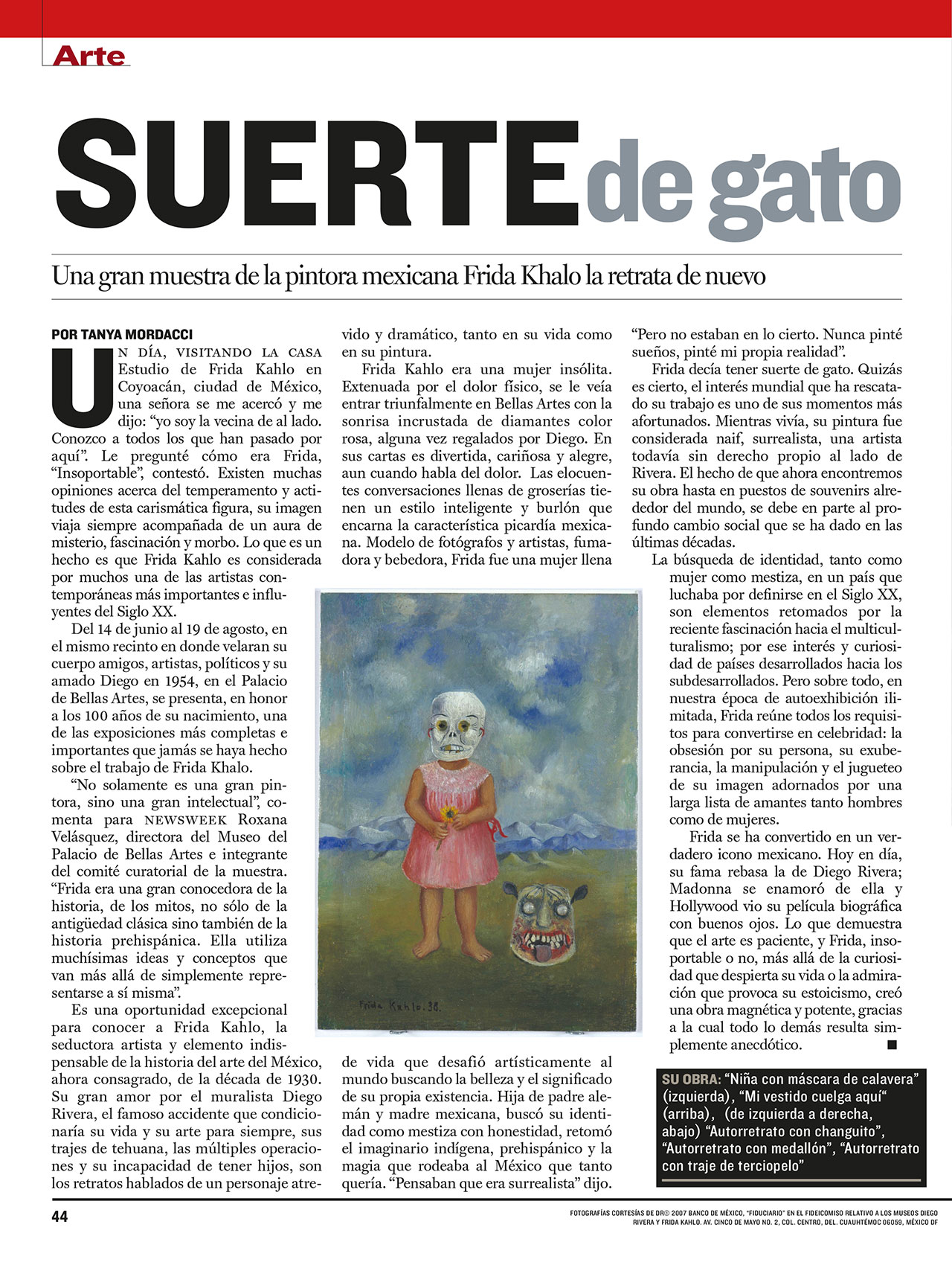
In the same place where friends, artists, politicians and her beloved Diego waked her death, the “Palacio de Bellas Artes” in Mexico City will host -honoring her 100th birth anniversary- one of the most important and thorough exhibitions ever accomplished about her work.
“Not only is she a great painter, but a great intellectual too.” Commented in an exclusive interview Roxana Velasquez, director of the “Museo del Palacio de Bellas Artes” and member of the curatorial committee of the exhibition, “Frida had great knowledge of history, of mythology, not only of classical but of pre-hispanic as well. She utilizes many ideas and concepts that go far beyond simply representing herself.”
This is an exceptional opportunity, from June 6 to August 19, to get to know Frida Kahlo, the seductive artist and indispensable element in the art history of the now consecrated, Mexican thirties.
Her great love for muralist Diego Rivera, the famous accident that would condition her life and her art forever, her “Tehuana” dresses, the multiple interventions and the unability to bear children are spoken portraits of a very daring and dramatic character, in her life as in her painting.
Frida Kahlo was an unusual woman. Strained by physical pain, she could be seen triumphantly entering “Bellas Artes”, her smile, crowned by pink-colored diamonds, once gifted by Diego.
In her letters she is amusing, warm and cheerful, even when speaking about pain. Her eloquent conversations full of curse words have an intelligent and ironic style, incarnating the characteristic Mexican “picardía” or humor. Model to photographers and artists, a drinker and a smoker, Frida was a woman charged with life who artistically defied the world looking for beauty and significance in her self-existence.
Daughter of a German father and Mexican mother, she searched for her identity not only as an artist, but as a “mestiza” with complete honesty, using the indigenous, pre-hispanic imaginary and the magic that has always surrounded the Mexico she some much loved. “They thought I was a surrealist” she said, “they were not right. I never painted dreams, I painted my own reality.”
Frida is said to have cat’s luck. Maybe it’s true, the world-wide interest that has recently rescued her art, is one of her most fortunate moments. While alive, her painting was considered naïve and surrealist, an artist still without proper rights next to Rivera’s. The fact of now finding her work even at souvenir shops around the world is due in part to a profound social change in the last few decades. The search for identity as a woman, and as a mestiza in a country fighting to define itself in the XX century, are elements which have been re-proposed by the recent fascination towards multi-culturalism; by the interest and curiosity from developed countries towards the underdeveloped.
But most of all, in our age of unlimited auto-exhibition, Frida reunites all the requisites for becoming a celebrity: her obsession with her persona, her eccentricity and the playful transformations of her self-imagery adorned by a long list of lovers, male and female. Frida has become a true Mexican icon. Today, her fame surpasses that of Rivera’s, even in auctions, where her works reach higher prices. Pop idol, Madonna, has fallen in love with her too and Hollywood granted her biography warmly with an Oscar.
Art can be patient, and Frida, unbearable or not, and all the curiosity her unusual life can awake or the admiration we might feel for her stoicism before pain, must result anecdotical when seeing her work, when feeling the magnetism and potency of her creation.