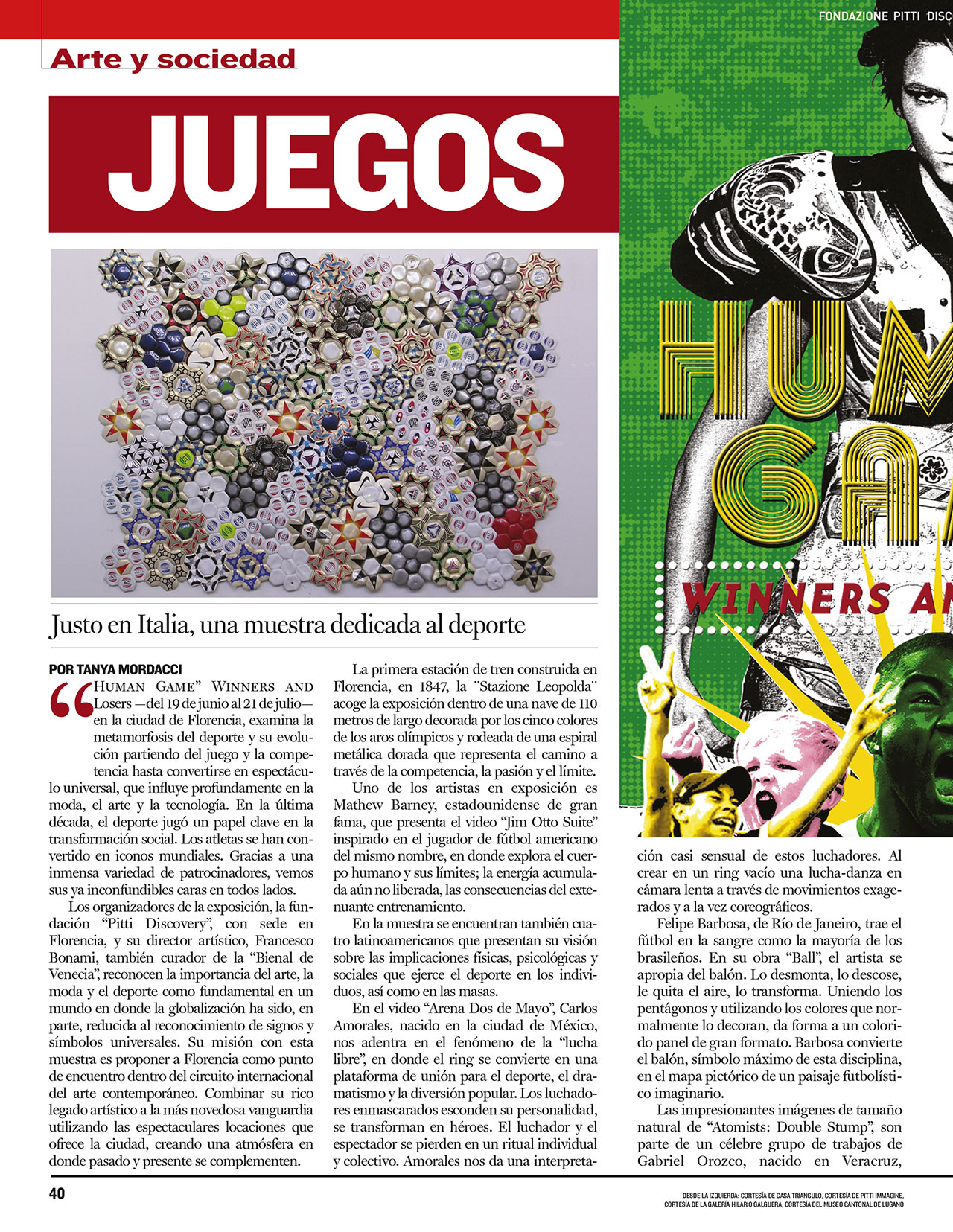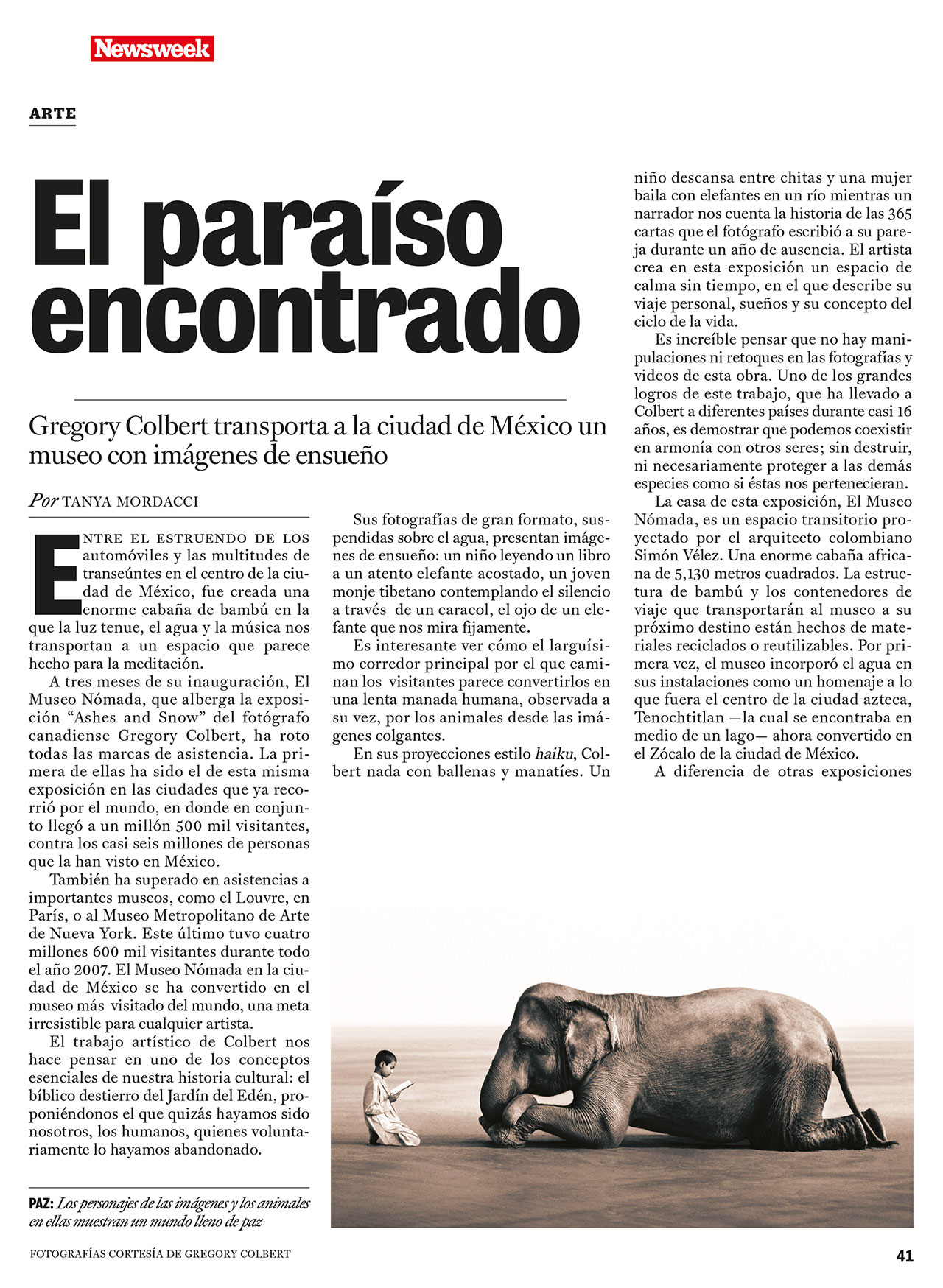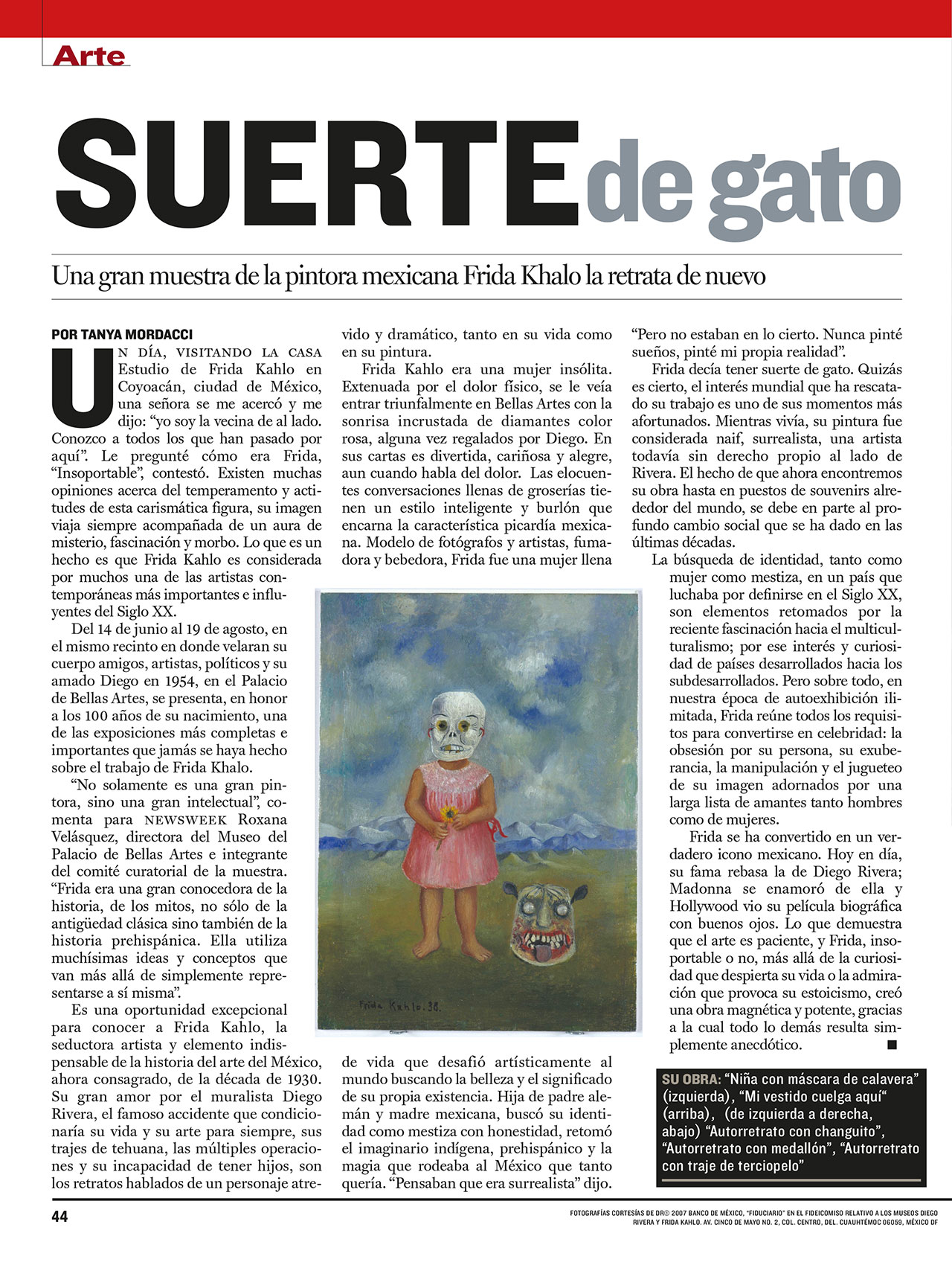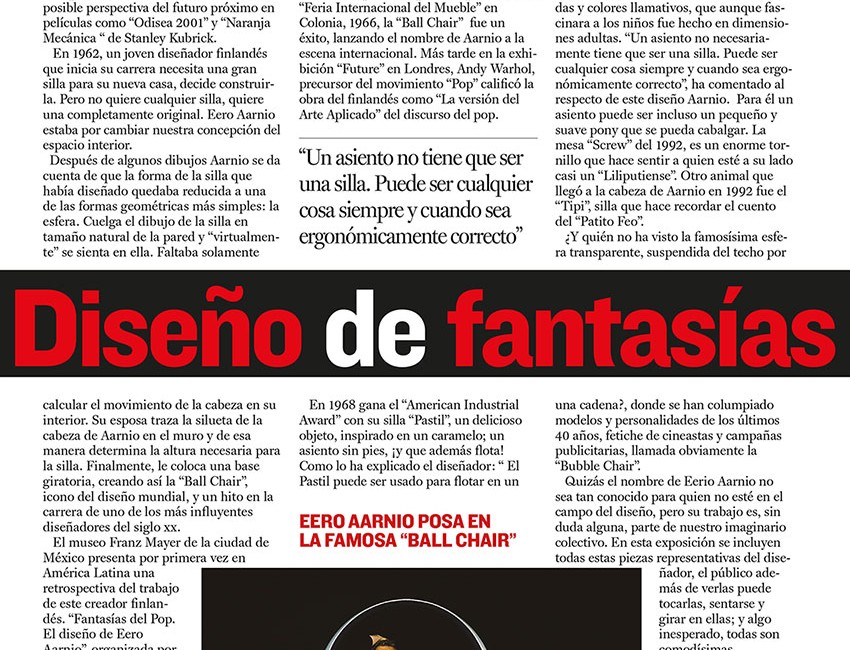
Despite the passing of time, we still marvel when looking at that generation of objects with daring shapes -created during the “Cold War” in the midst of the space age- of brilliant colors and made from a then innovative material, plastic. Designs that would make us dream, providing us with a possible perspective of the near future in films such as Kubrick´s “Odyssey 2001” and “A Clockwork Orange”.
In 1962, a young Finnish designer starting his career moves to a new home, needing a big chair, he decides to build it for himself. But he is not looking for just any chair; he wants a totally original one.
Eero Aarnio was about to change our conception of inner space forever.
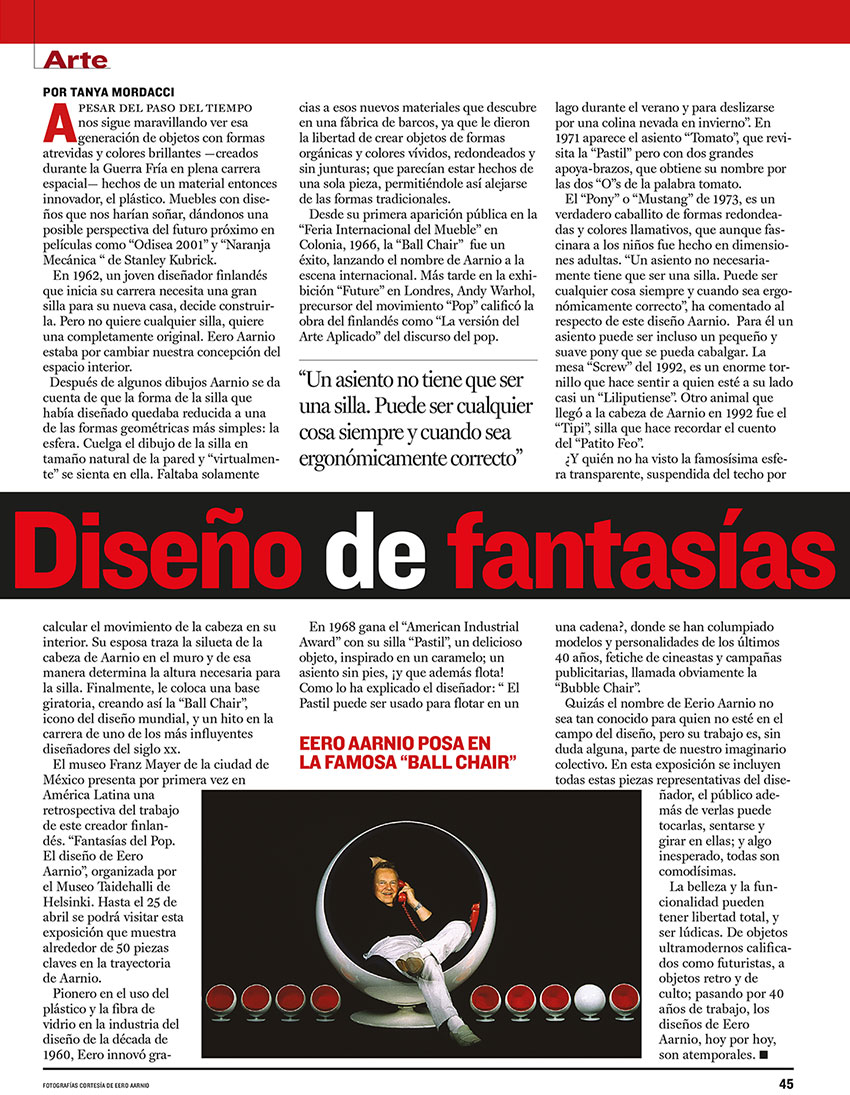
After some drawings, Aarnio realizes that the chair he is designing has been reduced to one of the simplest geometrical shapes: the sphere. He hangs the full scale drawing in the ceiling and “virtually” sits on it. Now, he has only to calculate the head’s movements once inside it. His wife traces Arnio’s head in the wall and that way he determines the necessary height for the chair. The rest was easy to design. Finally, he placed it on a rotatory stand, creating the “Ball Chair”, design icon and career breakthrough for one of the most influential designers of the XX century.
The “Franz Mayer” museum in Mexico City presents, for the first time in Latin America, a retrospective of the Finnish designer’s work. “Pop Fantasies. Eero Aarnio’s design”, organized by the “Taidehalli” museum in Helsinki.
Until April 25, 2007, the public can visit this exhibition showing around 50 key pieces of Aarnio’s trajectory.
Pioneer in the use of plastic and fiberglass in the design industry of the 60’s, Eero innovates thanks to those new materials, discovered in a shipyard, which gave him the liberty to create objects with organic forms and vivid colors. Rounded and without attachments; seemingly appearing to be made out of one piece, thus allowing him to leave behind what were the traditional shapes till then.
Since it’s first public appearance at the “International Furniture Fair” in Cologne, 1966, the “Ball Chair” was an immediate success, rocketing Aarnio into the international scene. Later, at the “Future” exhibition in London, artist Andy Warhol, leader of the “Pop” movement, qualified the Finnish designer’s work as the “Applied Art version” of “Pop’s” discourse.
In 1968, he wins the “American Industrial Award” with his “Pastil” chair, a playful object inspired in a sweet; a chair with no feet, that floats too! As Aarnio explains: “The Pastil can be used for floating in a lake during the summer and to glide down a snowy hill in the winter”. In 1971, the “Tomato” seat appears. A re-visitation of the “Pastil”, only with two big armrests, that acquire its name from the two big “O”s in the word tomato.
The “Pony” or “Mustang” from 1973 is truly a little rounded horse in sharp colors. Even if children were fascinated by it, the design was made for adult dimensions. “A seat does not necessarily have to be a chair. It can be anything as long as it is ergonomically correct”, as Aarnio has said. For him, a seat can even be a small and soft pony, which one can ride or sit on. The “Screw” table from 1992 is a giant-sized screw that can make anybody close to it feel like a “Lilliputian”. Another animal that came to Aarnio’s mind in 1992 was the “Tipi”, a chick-shaped chair that reminds us of the “Ugly Duckling”.
And who has not ever seen the famous transparent sphere, suspended from the ground by a chain? Where models and celebrities have swung for the past forty years, fetish for filmmakers and photo-shoots, obviously called the “Bubble Chair”.
Eero Aarnio’s name might not be as well known for those outside the design world, but his work is, undoubtedly part of our collective imagery. This exhibition includes all the designer’s most representative pieces, where the public not only can appreciate them, but can touch, sit and turn inside them; something quite surprising is that they’re all very comfortable.
Beauty and functionality can enjoy total freedom, and be even playful. From ultra-modern objects -qualified as futuristic- to retro and cult objects; crossing through forty years work, Eero Aarnio’s designs are, up to date, timeless.
This article is property of Newsweek Latin America. Photos courtesy of Eero Aarnio